A small exploratory data project based on my past and present poetry preferences.

Why This Project
I chanced upon Love’s Witness: Five Centuries of Love Poetry by Women (edited by Jill Hollis), in 2025.
The depth, range, and nuance of the poems was impressive.
I also noticed it was very different from my earlier poetry preferences, which were predominantly written by a small number of male writers.
It was fascinating to explore some personal favorites as a BI-adjacent project.
Dataset
I created the dataset in Google Sheets.
Here’s my original version.
Includes details like:
- Poet Name
- Poem Title
- Country of Poets
Findings Summary
Using two datasets:
- recent phase poems
- earlier phase works
I explored thematic patterns, stylistic tendencies, and country‑level distribution across 29 poets.
The project demonstrates SQL fundamentals including joins, grouping, aggregation, and cross‑table analysis.
Key steps included:
- Cleaning and standardizing column names
- Importing CSVs into SQLite Online
- Running relational joins between poems and poets
- Comparing themes across phases
- Analyzing stylistic patterns
This project helped me build confidence with SQL joins and grouping logic, and gave me hands‑on experience troubleshooting real‑world data inconsistencies.
Sample Queries
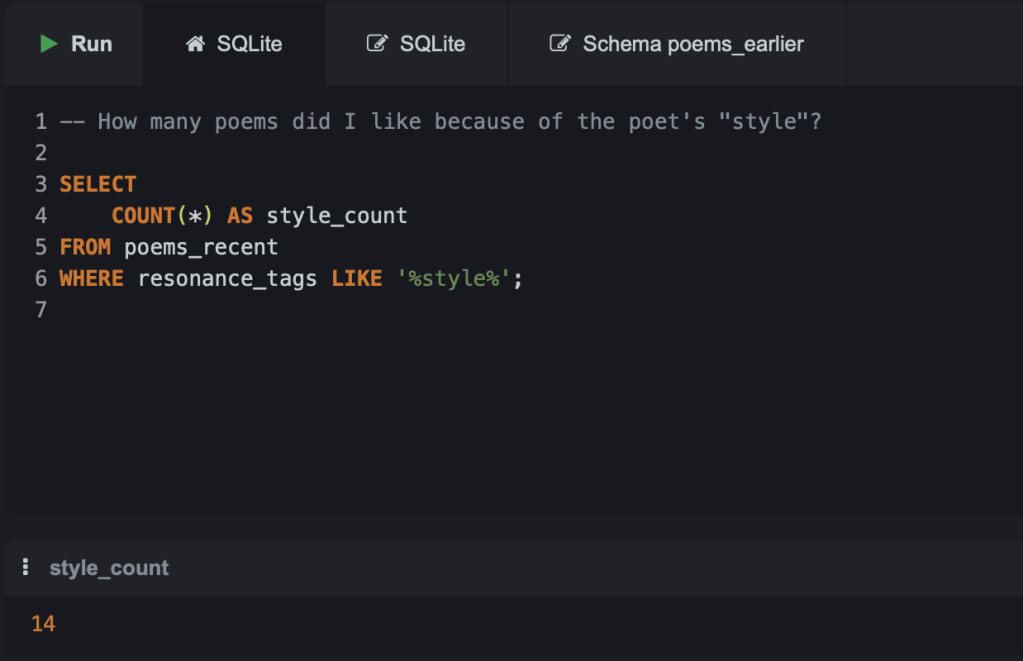
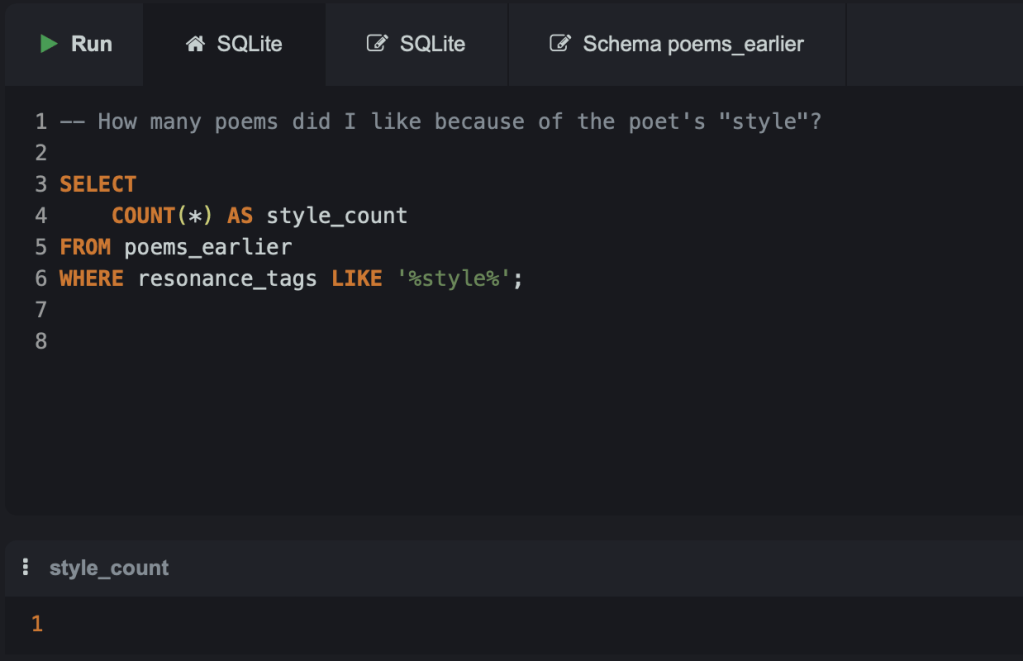
Query 1: “How many poems did I like because of the poet’s style?”
This shows application of the COUNT() function to return the rows that match the criterion, according to phase.
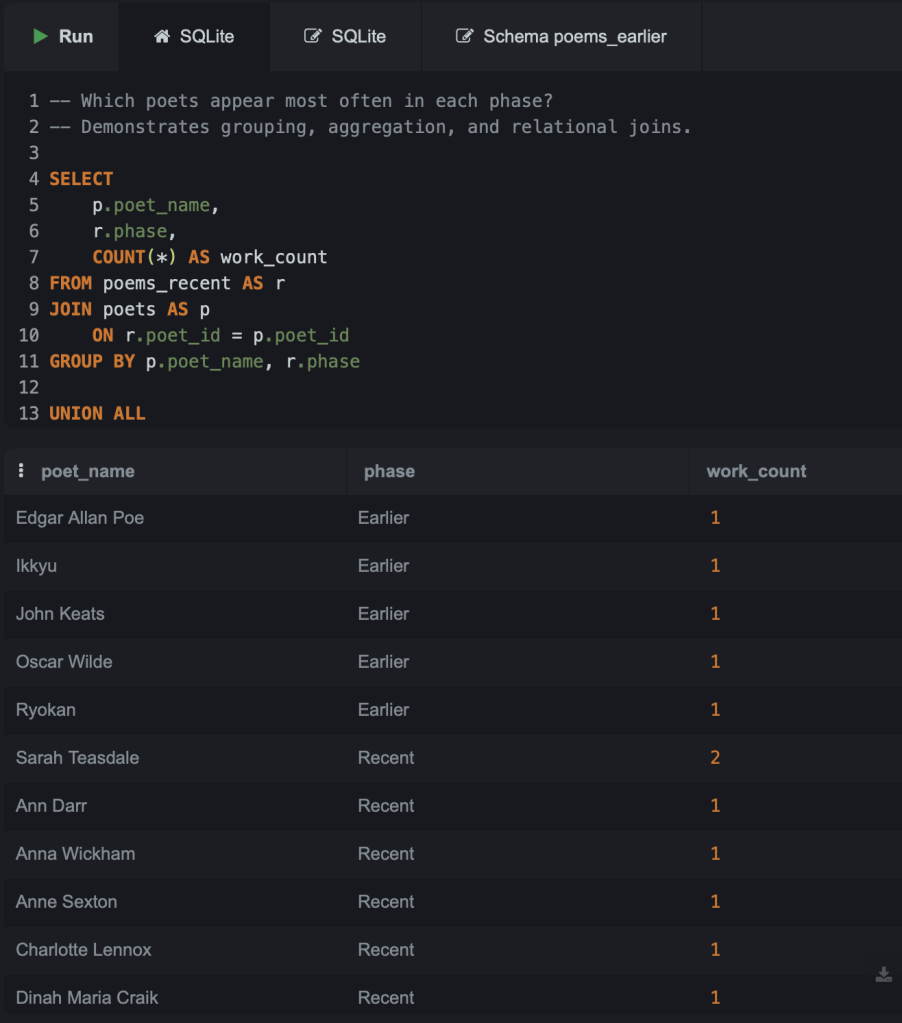
Query 2: “Which poets dominate each phase?”
This shows grouping + joining + phase comparison.
Note: Edgar Allan Poe would have taken the top spot easily, if I had added more examples for him.
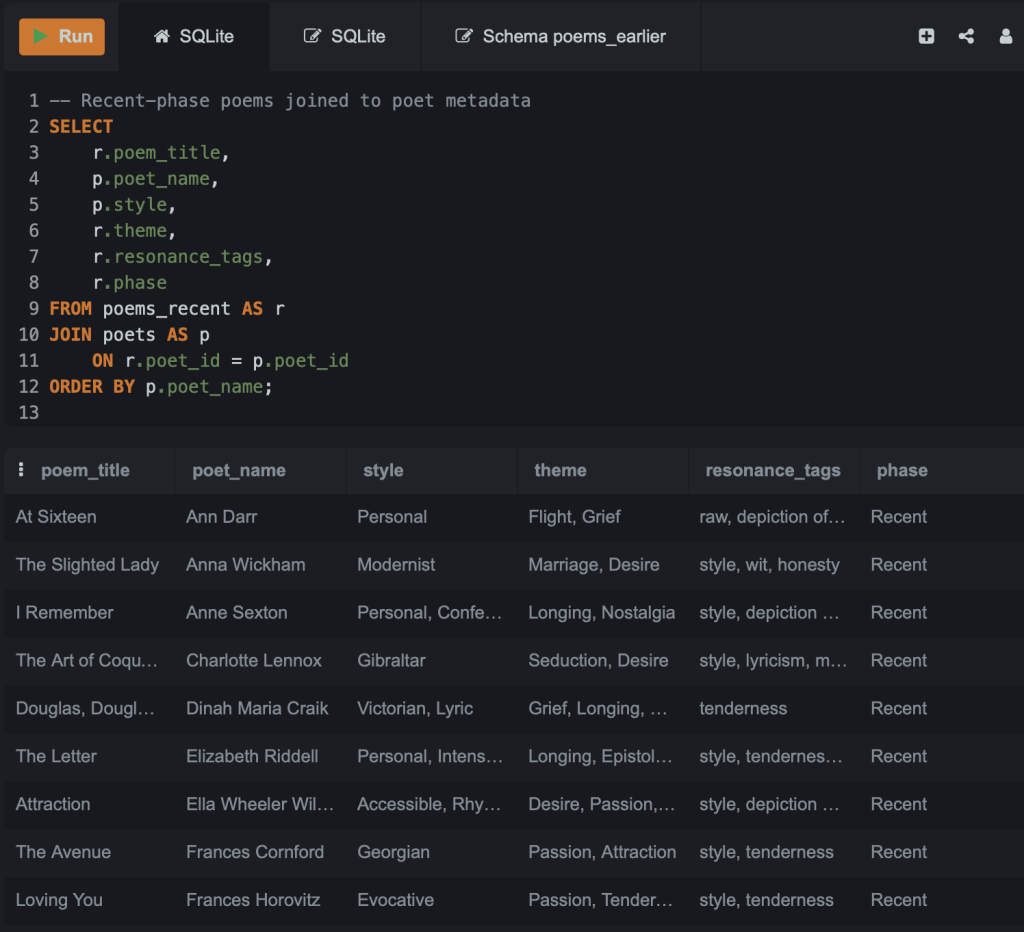
Query 3: “All recent poems with poet info”
This shows usage of a SQL Join to combine data from two tables based on a related column (poet_id).
Top 3 Insights
- Distinct emotional phases emerged. Earlier‑phase works leaned heavily toward Zen, longing, and existential themes, while recent‑phase poems showed more relational nuance and ethical reflection.
- Stylistic diversity increased over time. Recent‑phase poems showed a wider range of styles (personal, narrative, modernist), whereas earlier‑phase works clustered around Zen, Romantic, and Gothic traditions.
- Style preference in phases. The results show that I liked more than 50% of recent poems because of the poet’s style, compared to 20% of earlier poems for the same reason.
Additional Insight: Why Normalization Matters
While working with the resonance_tags column, I realized that many rows contained multiple values inside a single cell (e.g., “style, lyricism, idealism”).
When I tried to group or count individual tags, SQL treated the entire string as one category.
This experience helped me understand why normalization is important: storing one value per cell makes querying, grouping, and analysis much cleaner and more flexible.
For this project, I used LIKE filters to answer my questions, but in a future iteration I may create a separate resonance_tags table (one row per tag) for more streamlined analysis.

