
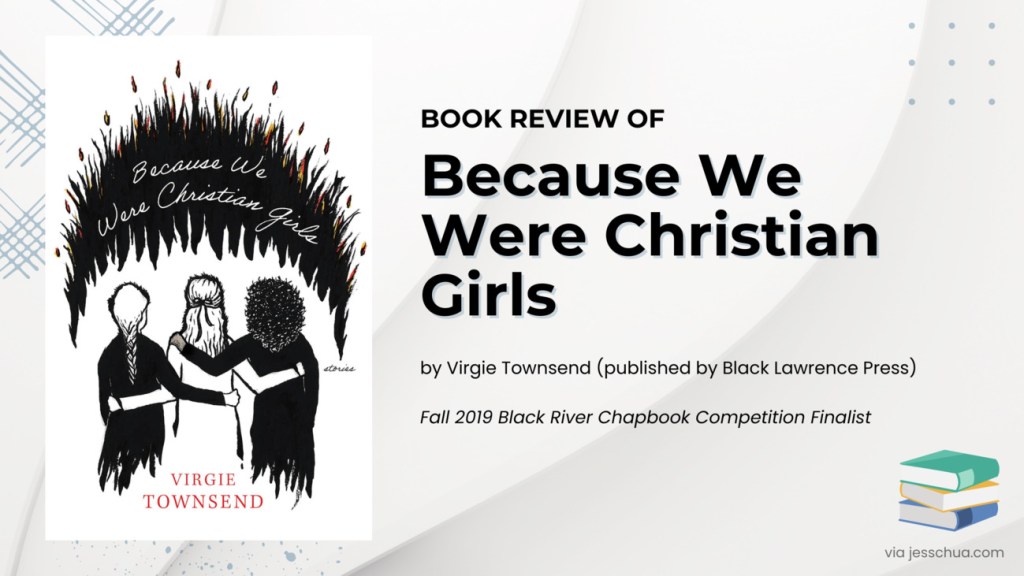
Back in 2023, I decided to dive into the wonderful world of chapbooks.
In a best case scenario, I’d imagine a debut short fiction chapbook to be a strongly immersive, memorable read. I got this experience with Virgie Townsend’s chapbook.
Because We Were Christian Girls’ accolades include winning:
- the 2022 Central New York Book Award for Fiction
- finalist for the 2021 Newfound Prose Prize and Black Lawrence Press’ Fall 2019 Black River Chapbook Competition
- an honorable mention in the Cupboard Pamphlet’s 2020 Annual Contest
Learning that these seven fictitious stories were inspired by the author’s “own experiences growing up in an independent fundamental Baptist church” got my attention from the get go.
The first story features the line:
“Nobody knows who’s it or who’s supposed to be hiding or who’s supposed to be seeking.”
This perfectly captures the conundrum of being a good Christian girl, where there’s always a fear of the unknown or uncertainty—where even if you follow all the rules, you still have this underlying feeling of Jesus “[loving] us, but [hating] our sin”—where someday on the horizon, you’re just “supposed to submit” to male figures.
The collection’s eponymous story follows next, where a Christian camp’s assistant pastor teaches the protagonist a lesson on disobedience with a good measure of shame, gender inequality, and embarrassment. For all “Christian girls know what happens when they disobey,” and that “a lot more goes into being a Christian girl than just believing in Christ.”
The story “Heavenly Bodies” takes the reader on a journey through yet more conundrums that the average teenage girl goes through.
Two friends, Erin and Stephanie, analyze a photo of a 2000s mega popstar flaunting her abs for the world. Townsend excellently captures the constant anxiety weighing on the teenage girls in this situation, where they’re expected to deftly maneuver the lines between sexuality, religious commitment, and adhering to social beauty standards.
Despite these pressures, I like how Erin considers “what would happen if she wasn’t taken up in the Rapture,” and her actions toward the end of the story. We learn how she is young but aware of the contrast of the sexless “glorified bodies” up in heaven versus the more complicated version of a physical body grounded on earth.
“Instructions” is one of the shorter stories, but one that still lands with quiet force. What do you do when same-sex attraction enters the tightly scripted world of Christian girlhood? You listen to adults whose advice is based on “what Jesus wants.” This story captures anxiety in moments of the seemingly mundane, where a visit from a girlfriend is transformed into the microcosm of religious morals that act as a yoke around one’s neck when it comes to the pressures of gender conformity.
Without giving away too much of the story, I loved the selection of “What Fundamentalists Do” as the piece to complete this chapbook. The last story features the line:
“I know why Eve ate from the Tree of [Knowledge]. . .She loved God, but she had a hungry mind.”
The story ends with a fitting last line, one that comes from a place of compassion instead of self-righteousness or judgment.
The acknowledgments page is worth a read as well. Over there, we get a glimpse of the author’s inspiration for research and insights as she sought to describe the experiences in terms of community and not just through an individual lens.
It is there that the author remarks having written a book about “salvation and damnation.”
It’s also a reminder that we’re rarely alone in our journey when we examine our own thoughts and beliefs, in order to know where we may truly belong.
➜ Check out “Because We Were Christian Girls” at Black Lawrence Press
 Jess Chua
Leave a comment